

A kiosk terminal that keeps showing the desktop instead of the app it was built for is not broken, it is being overridden by a policy nobody documented.
Windows was designed around a full desktop experience, but not every device needs one. Purpose-built endpoints such as digital signage, line-of-business terminals or shared kiosks often only need a single running application, not Explorer, not a Start menu, not a taskbar. The lightweight shell exists precisely for this scenario.
When shell replacement is left to chance, or configured through multiple overlapping mechanisms, the result is unpredictable behavior. A device may boot into the desktop shell one day and into a locked-down interface the next, and troubleshooting becomes guesswork instead of diagnosis.
The OverrideShellProgram setting gives administrators a single, authoritative way to tell Windows which shell to launch at logon. When enabled, Windows replaces the standard desktop shell with the lightweight shell, a minimal interface with no desktop, no Start menu and no taskbar.
Enforcing this through Microsoft Intune removes ambiguity. Every targeted device receives the exact same shell configuration, evaluated the same way, without relying on local scripts, legacy Shell Launcher profiles or manually staged images.
The result is an environment where purpose-built devices behave exactly as intended, with a predictable interface, a reduced attack surface, and a configuration that can be audited and reproduced across the entire fleet.
Why This Policy Matters
Shell configuration is one of the most overlooked layers of device hardening. Attackers and curious users alike look for the shell as their first foothold, because whoever controls the shell controls what the user can reach next.
OverrideShellProgram closes that gap for devices that should never expose a general-purpose desktop in the first place, but only if it is the sole authority making that decision.
Without this policy:
- A shared or unattended device can boot into the full desktop shell, exposing Explorer, the Start menu and installed applications to anyone at the console
- Conflicting shell configurations, such as a leftover Shell Launcher profile, can silently fight this policy and produce inconsistent behavior across identical hardware
- Users can right-click their way out of a supposedly locked-down interface into the underlying operating system
- Troubleshooting becomes reactive, since there is no single documented source of truth for which shell a device is actually running
With this setting enforced through Intune:
- Every targeted device launches the same lightweight shell at logon, with no manual staging required
- The desktop, Start menu and taskbar are never exposed on devices where they should not be
- Administrators can identify, in advance, whether a device already has a conflicting shell policy assigned
- Shell behavior becomes reproducible and auditable across the entire managed fleet
This configuration aligns with modern security principles such as defense in depth, endpoint hardening, proactive threat detection, and Zero Trust architecture.
Security Governance
Security governance ensures that hardening controls are consistently applied, monitored, and aligned with organizational standards.
Without centralized governance, settings such as this one can drift across devices, leaving blind spots that attackers can exploit.
Managing the Override Shell Program setting through Microsoft Intune brings several governance benefits:
- Centralized enforcement of the control across all managed Windows endpoints
- Consistent configuration aligned with corporate security baselines
- Clear visibility into deployment status and configuration compliance
- Defined ownership and accountability through scope tags and role-based administration
- An auditable policy lifecycle from creation to enforcement and validation
This level of governance ensures that the control is handled in a controlled and transparent manner, reinforcing compliance with internal security policies and regulatory frameworks.
Windows CSP Overview
This section explains how the setting is exposed at the operating system level and how Microsoft Intune interacts with it. The configuration is powered by the Windows Policy Configuration Service Provider (CSP) framework, specifically the WindowsLogon area.
| Scope | Editions | Applicable OS |
|---|---|---|
| ✅ Device ❌ User | ✅ Pro ✅ Enterprise ✅ Education ✅ IoT Enterprise / IoT Enterprise LTSC | ✅ Windows 11, version 22H2 [10.0.22621.2338] and later |
OverrideShellProgram policy allows IT admin to configure the shell program for Windows OS on a device. This policy has the highest precedence over other ways of configuring the shell program. The policy currently supports below options: 1. Not Configured: Default shell will be launched. 2. Apply Lightweight Shell: Lightweight shell doesn't have a user interface and helps the device to achieve better performance as the shell consumes limited resources over default shell. Lightweight shell contains a limited set of features which could be consumed by applications. This configuration can be useful if the device needs to have a continuous running user interface application which would consume features offered by Lightweight shell. If you disable or don't configure this policy setting, then the default shell will be launched.
Description Framework Properties
This section defines how the configuration behaves at a technical level within the CSP framework.
| Property name | Property value |
|---|---|
| Format | int |
| Access Type | Add, Delete, Get, Replace |
| Default Value | 0 |
Allowed Values
This section defines the valid configuration values supported by the setting. It accepts the following options:
| Value | Description |
|---|---|
| 0 (Default) | Not Configured. |
| 1 | Apply Lightweight shell. |
Group Policy Mapping
For organizations operating in hybrid environments, this CSP setting maps to a corresponding Group Policy configuration.
| Name | Value |
|---|---|
| Name | OverrideShellProgram |
| Location | Computer Configuration |
Security Considerations
Before enabling this policy, administrators should understand how it behaves and plan for its impact.
- OverrideShellProgram takes precedence over every other shell configuration method, including Shell Launcher and Assigned Access, so an existing kiosk profile on the same device will be silently overridden
- The lightweight shell has no desktop, Start menu or taskbar, so any application that assumes a standard shell environment may fail to launch correctly
- This policy applies only at device scope, on Windows 11 version 22H2 (build 10.0.22621.2338) and later, on Pro, Enterprise, Education and IoT Enterprise editions
- Once applied, recovering a misconfigured device may require console access or a remote remediation script, so test on a disposable device before wider rollout
A phased, pilot-first deployment is recommended to validate the behavior in a controlled group and avoid unexpected impact before rolling the setting out across production devices.
How to Configure Override Shell Program Using Intune (Settings Catalog)
You can enforce this policy centrally using the Intune Settings Catalog, ensuring that only devices intended to run the lightweight shell receive it, and that no conflicting shell configuration remains in place, is applied consistently across all managed Windows devices.
To begin, sign in to the Microsoft Intune admin center and follow the steps below, as illustrated in the screenshots.
Create the Configuration Profile
In the Microsoft Intune admin center:
- Navigate to Devices › Windows › Configuration
- Select + Create policy
In the Create a profile pane:
- Platform: Windows 10 and later
- Profile type: Settings catalog
Click Create to continue.
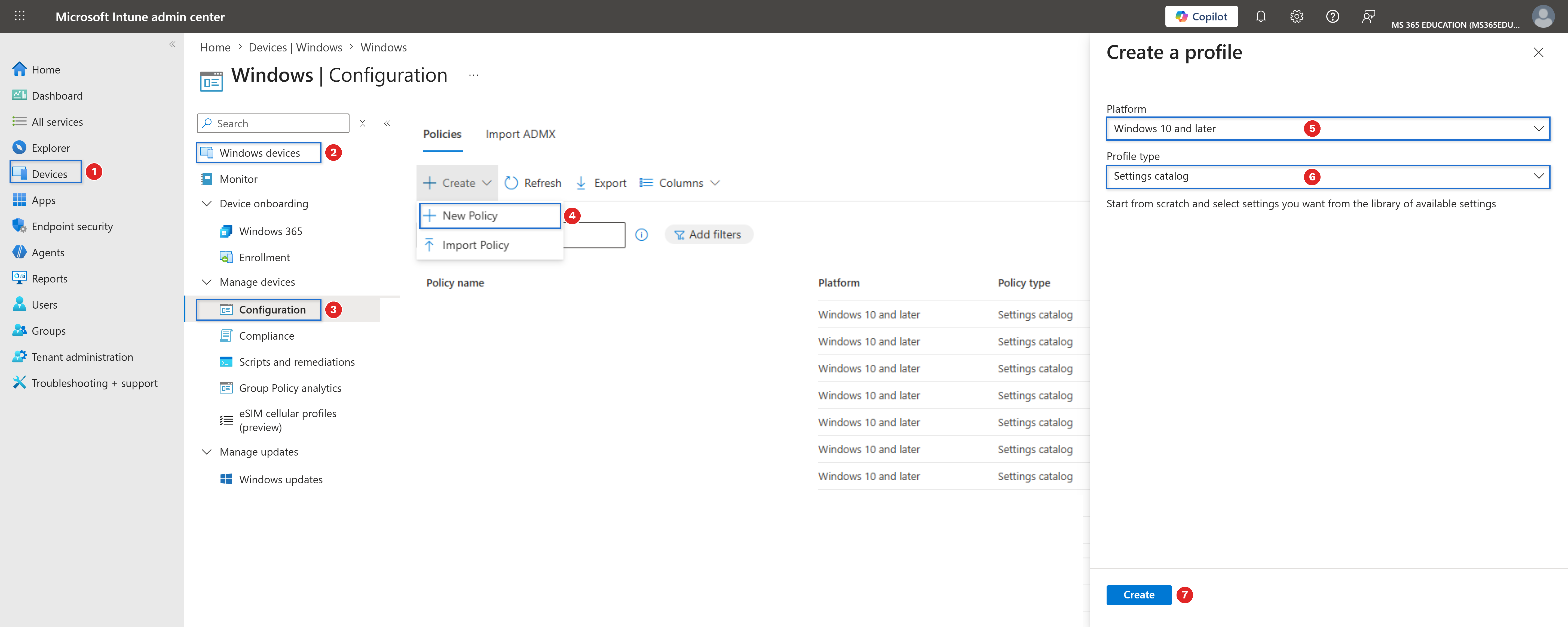
At this stage, you have created the foundation of a Settings Catalog policy. In the next steps, you will search for and configure the setting that replaces the default desktop shell with the lightweight shell on purpose-built devices.
Define Basic Profile Details
After clicking Create, the next step is to define the basic details of the configuration profile. This stage is essential for long-term management, clarity, and governance within Microsoft Intune, especially in environments with multiple endpoint hardening policies and security baselines.
Providing a clear Name and a concise but meaningful Description ensures that the purpose of the policy is immediately understood by administrators and security teams in the future. As shown in the screenshot, configure the fields as follows.
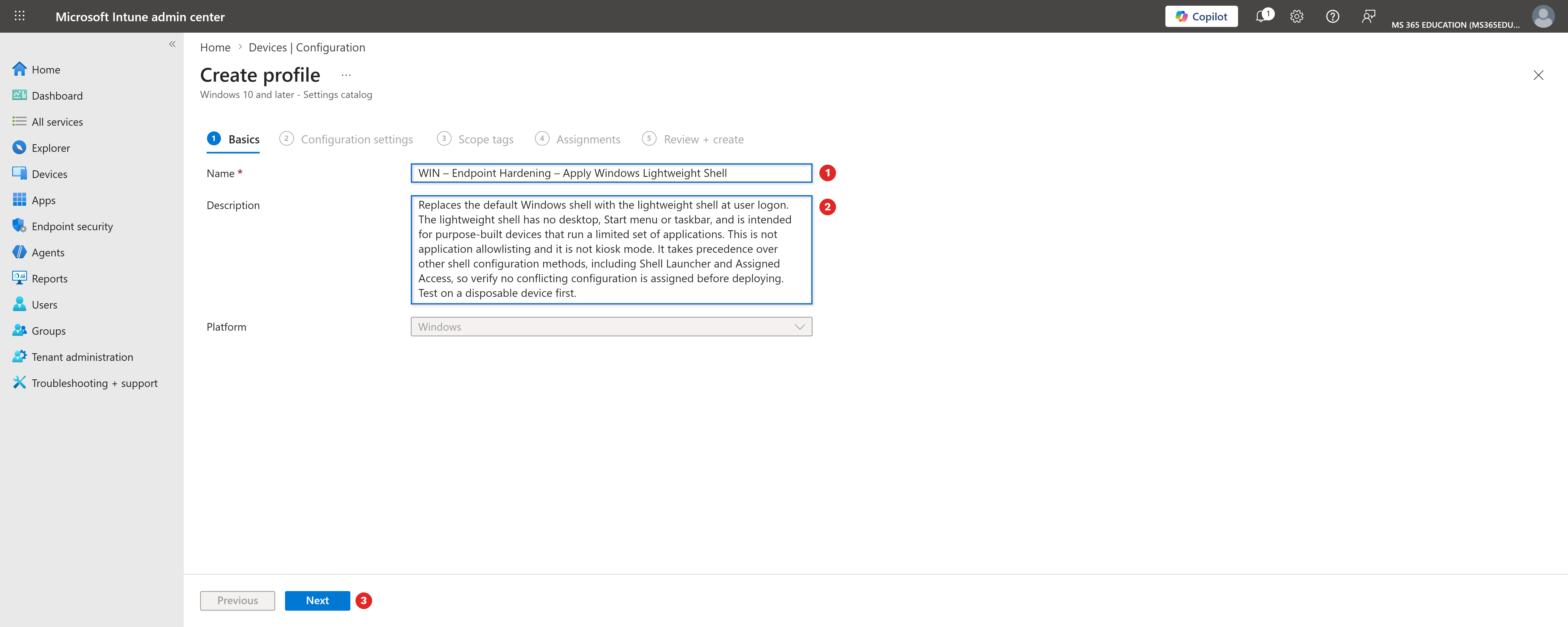
The Platform field is already pre-selected as Windows, so no changes are required. Once the name and description are defined, click Next to proceed to the configuration settings.
Configure the Setting Using the Settings Picker
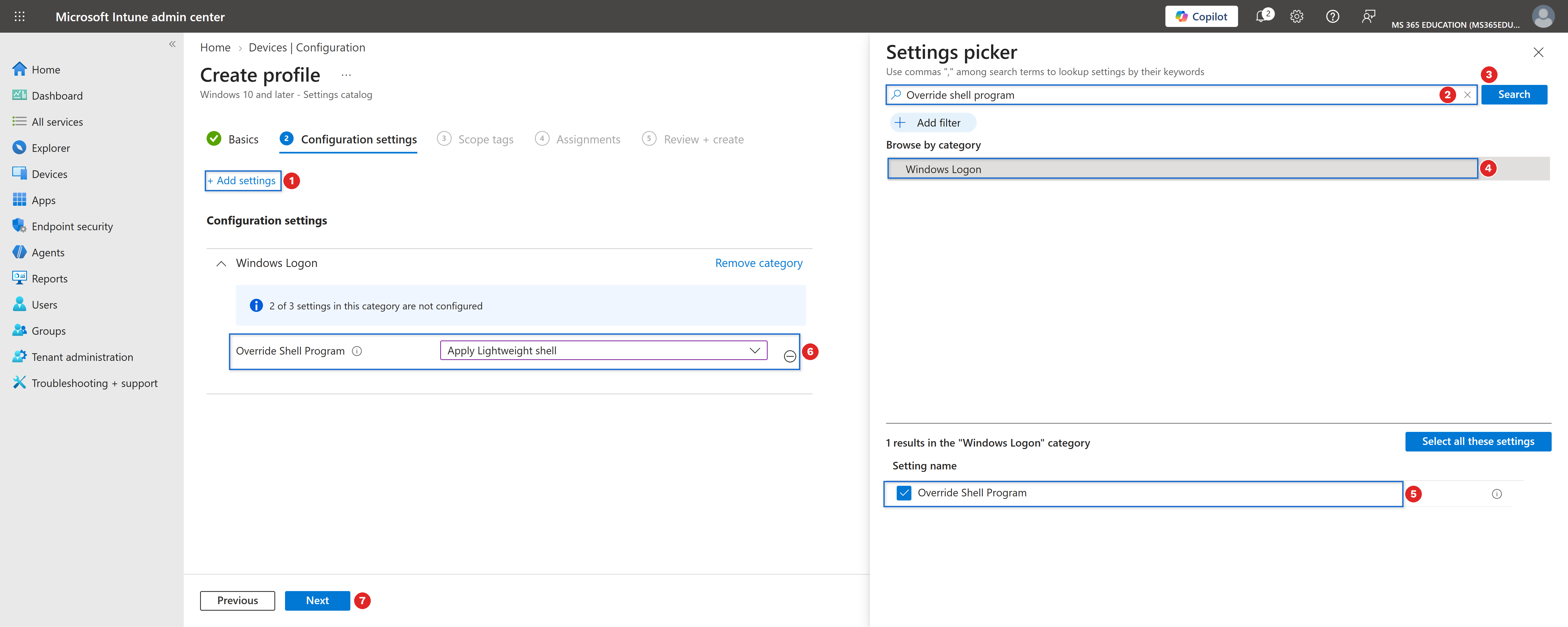
With the profile basics defined, the next step is to configure the policy using the Settings picker, where you select the exact Windows setting you want to enforce. To open the Settings picker panel, click Add settings.
By default, this setting is Not Configured, meaning Windows launches the standard desktop shell (explorer.exe) at logon exactly as it always has.
In the search field at the top of the Settings picker, type Override shell program, and then click Search to filter the results.
From the returned results, select the category Windows Logon, and then choose the setting Override Shell Program. Once selected, the setting is automatically added to the configuration profile. Back on the configuration page, change the value from its default state to Apply Lightweight shell (1).
When enabled, Windows replaces explorer.exe with the lightweight shell at the next logon. This ensures that:
- The device presents no desktop, Start menu or taskbar to the logged-on user
- The device's usable surface is limited to the single application the lightweight shell is intended to host
- The configuration takes precedence over any Shell Launcher or Assigned Access profile also assigned to the device
This configuration aligns with modern endpoint hardening practices and supports Zero Trust security principles.
Configure Scope Tags (Optional)
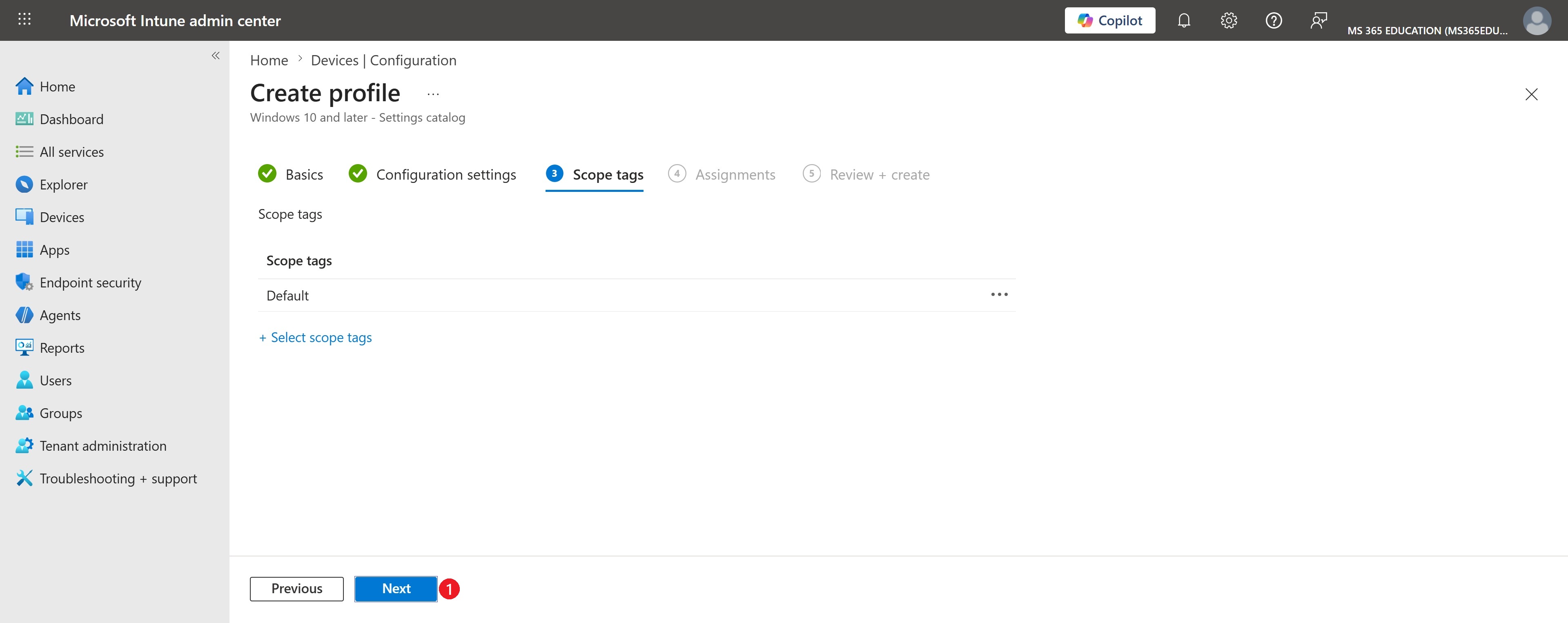
Scope tags are used to control who can view and manage this policy within the Microsoft Intune admin center. They are particularly useful in environments with delegated administration, multiple IT teams, or regional management models.
As shown in the screenshot, the Default scope tag is selected. This is the standard and recommended configuration for most environments, as it ensures the policy is visible to all administrators who have access to Intune.
Optionally, custom scope tags can be assigned if you need to:
- Restrict policy visibility to specific IT roles or teams
- Enforce administrative separation of duties
- Support delegated or region-based Intune management
If no additional scope tags are required, keep the Default selection and click Next to continue.
Assignments – Lightweight Shell Deployment
After configuring the policy settings, the next step is to assign the policy to the appropriate target group. Assignments define which devices will receive and enforce this configuration, ensuring the policy is applied in a controlled and intentional manner.
In the Assignments tab, click Add groups under Included groups and search for the group you want to target. This approach allows you to deploy the policy gradually, starting with test devices before expanding to production.
As shown in the screenshot, the policy is assigned to the following group: GRP – MS365Education – Test Computers.
Once the group is selected, verify the following:
- The group appears under Included groups
- The group status is Active
- No assignment filters are applied (unless explicitly required)
At this stage, no Excluded groups are configured, which is appropriate for controlled test deployments.
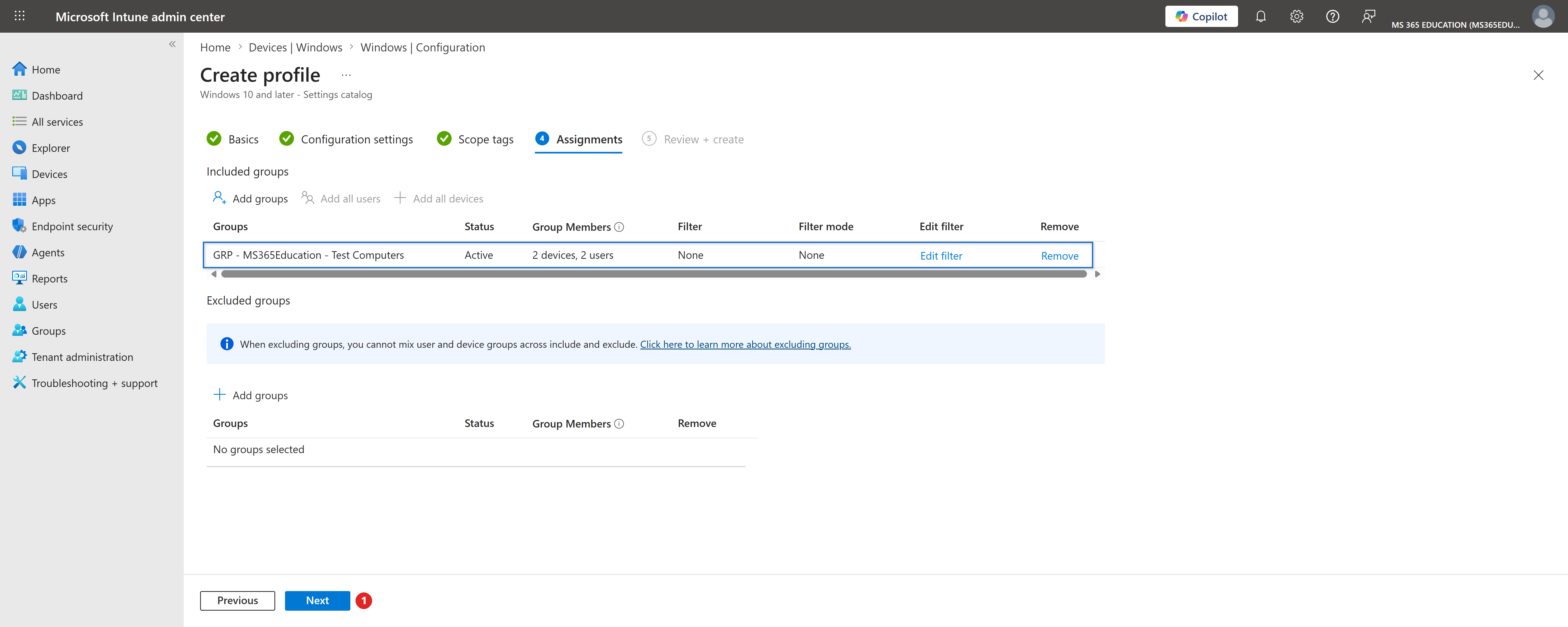
After confirming the assignment, click Next to proceed to the Review + Create step.
Review + Create – Final Validation
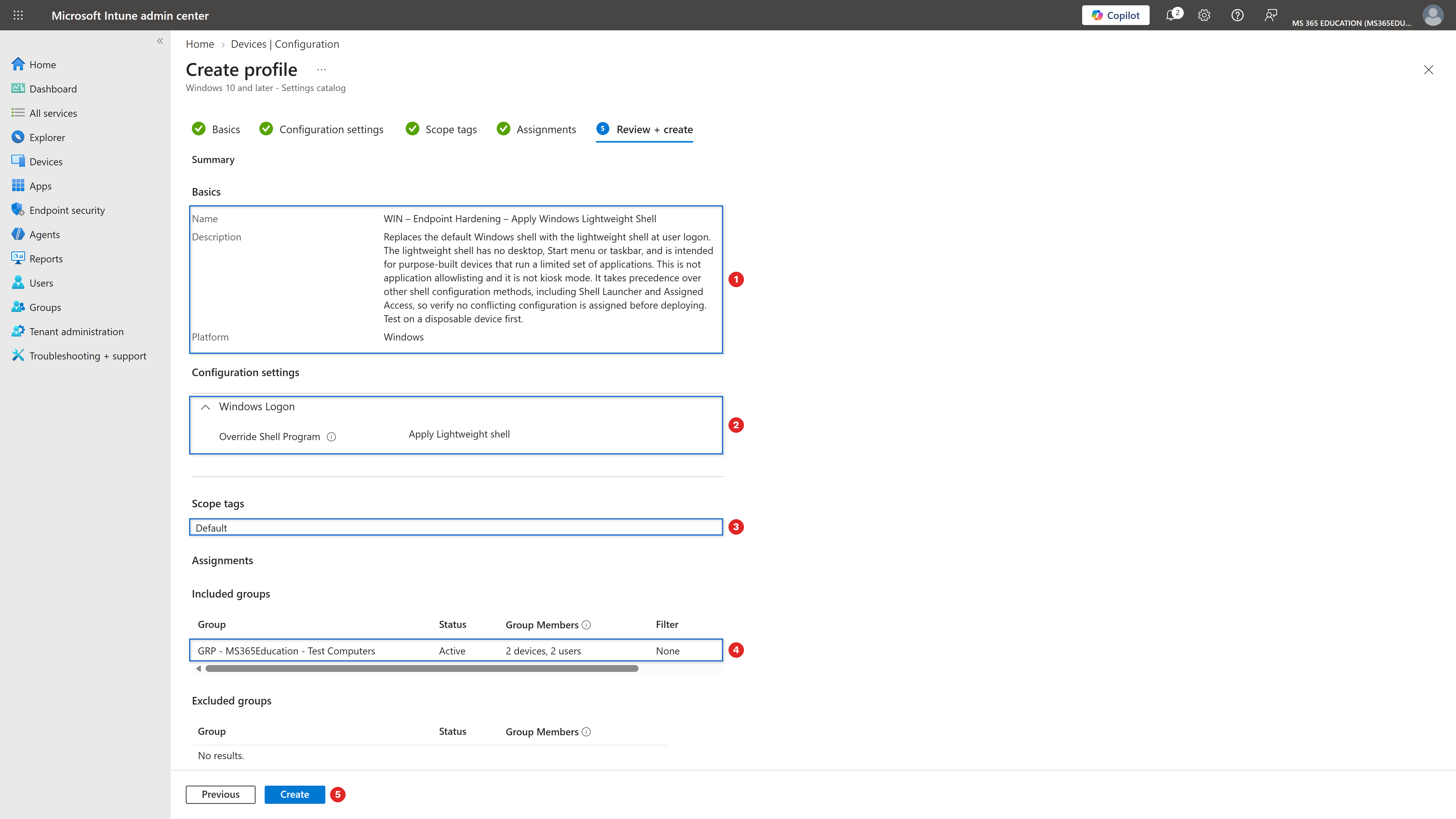
The Review + Create step is the final checkpoint before deploying the policy. This is where you validate that all configurations are correct and aligned with your intended endpoint hardening objective.
Pay special attention to the following items:
- Policy name and description: confirm that the policy clearly reflects its purpose, replacing the default shell with the lightweight shell on purpose-built devices
- Configuration settings: verify that Override Shell Program is set to Apply Lightweight shell (1), under Windows Logon
- Scope tags: ensure the correct scope tag is assigned. In this example, the Default scope tag is used
- Assignments: confirm the policy is assigned to the intended group, GRP – MS365Education – Test Computers, and that no unintended exclusions are configured
Once everything has been validated, click Create to finalize and deploy the policy to the assigned devices.
Monitor Policy Deployment Status
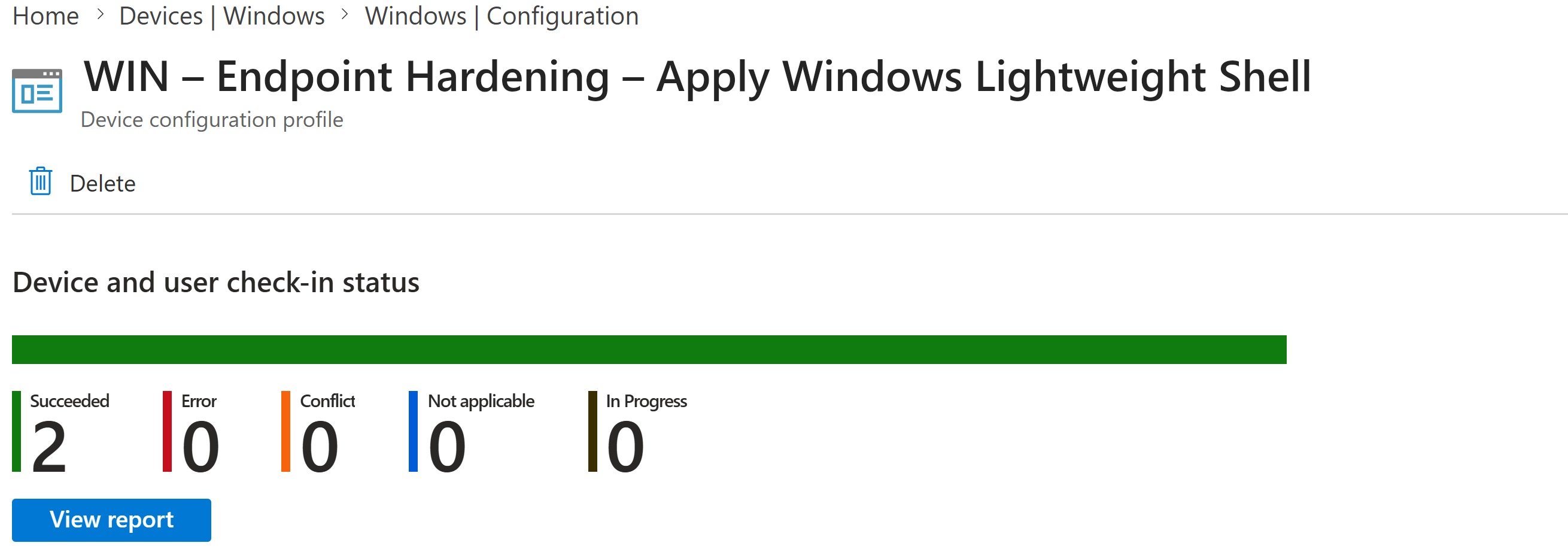
After creating and assigning the WIN – Endpoint Hardening – Apply Windows Lightweight Shell configuration profile, the next step is to verify its deployment status. This validation confirms that the policy has been successfully applied and that the lightweight shell is running instead of the standard desktop shell on the targeted devices.
Although Microsoft Intune can take up to 8 hours to automatically deliver configuration profiles, deployment often occurs much faster. If needed, you can accelerate the process by:
- Triggering a manual device sync from the Company Portal
- Initiating a sync directly from the Microsoft Intune admin center
Intune provides clear indicators to evaluate the policy deployment status: Succeeded (devices have applied the policy), In progress (devices are still processing), Error (the policy failed and requires investigation), and Not applicable (the device does not support the configuration).
When devices report Succeeded, it confirms that the lightweight shell has taken precedence over the default desktop shell, ensuring that the device now exposes only the minimal, purpose-built interface it was configured for.
Client-Side Verification via Event Viewer
After the device has synced with Intune, you can perform a client-side verification to confirm that the policy was successfully applied. Windows records Intune policy processing events locally, allowing administrators to confirm policy enforcement without relying only on the Intune portal.
- Open Event Viewer on the target device
- Navigate to Applications and Services Logs › Microsoft › Windows › DeviceManagement-Enterprise-Diagnostics-Provider › Admin
- Select Filter Current Log
- Look for Event ID 813 or Event ID 814, which indicate successful processing of Intune configuration policies
- Open the event details and confirm that the WindowsLogon setting was applied
For deeper validation, you can confirm the effective setting directly on the device by checking the registry path HKLM\SOFTWARE\Microsoft\PolicyManager\current\device\WindowsLogon\OverrideShellProgram, which should contain the value 1 once the lightweight shell is enforced. You can also confirm at logon that no desktop, Start menu or taskbar is presented, and that Task Manager no longer lists explorer.exe as the active shell process.
Remember that this policy takes precedence over Shell Launcher and Assigned Access. If either of those is also assigned to the same device, OverrideShellProgram will override their configuration, so audit any existing kiosk profiles before rollout to avoid unexpected lockouts.
Why This Matters for Endpoint Security
Shell configuration is often treated as a cosmetic decision, but on purpose-built devices it is a security boundary. Whatever shell Windows launches at logon defines the entire reachable surface for that session.
Without this control, a shared kiosk, a signage screen or a fixed-function terminal can default back to the full desktop shell, exposing Explorer, installed applications and system settings to anyone standing in front of it.
By enforcing Override Shell Program through Microsoft Intune and validating the configuration locally, organizations ensure that:
- Purpose-built devices remain locked to the single application they were designed to run
- The desktop shell, and everything reachable through it, is never exposed on devices that should not have it
- Shell configuration is consistent, documented and reproducible across the entire managed fleet
- Conflicts with other shell replacement mechanisms are identified before they cause unpredictable device behavior
This configuration provides strong security value without disrupting standard user workflows when properly validated and deployed.
Key Takeaway
A device's shell is its front door, and if it is not deliberately restricted, it remains open to whatever the user tries next.
Enforcing OverrideShellProgram through Microsoft Intune guarantees that the lightweight shell, not the full desktop, is what greets the user on every device where it is assigned.
Combined with centralized deployment and client-side validation, the organization gains a fleet of purpose-built endpoints that behave predictably, resist tampering, and are easy to audit at scale.
And in modern security architecture, deliberate shell control is not optional, it is essential.
More Information
For additional technical details, refer to the official Microsoft documentation below:
- https://learn.microsoft.com/en-us/windows/client-management/mdm/policy-csp-windowslogon#overrideshellprogram
- https://learn.microsoft.com/en-us/mem/intune/configuration/settings-catalog
- https://learn.microsoft.com/en-us/mem/intune/configuration/device-profiles
- https://learn.microsoft.com/en-us/mem/intune/configuration/device-profile-monitor
- https://learn.microsoft.com/en-us/mem/intune/configuration/device-profile-troubleshoot
Thank you for reading!
🖥️ Ricardo Barbosa
🏆️ Microsoft MVP | 📘 Microsoft Certified Trainer (MCT)
☁️ Intune & Cloud Architect | 💼 Technology Director at Altelix.com
💬 Follow me for more Windows endpoint hardening and Intune content.